Strategy: As part of UWG's Quality Enhancement Plan (QEP), UWG will increase the number of opportunities, awareness, and participation in experiential learning (multiple approaches including undergraduate research, study abroad, internships, etc.)
Background: UWG’s Quality Enhancement Plan (QEP—Career Readiness through Experiential Learning—seeks to strengthen the connection between experiential learning and the development of career readiness competencies for undergraduate students, beginning in their very first semester and continuing through their senior-level courses as they transition to their careers. Approved by SACSCOC in 2024 and officially launched in January 2025, the QEP will focuses on two types of experiential learning: undergraduate research and work-based learning. The QEP supports UWG’s current Strategic Plan, which aims to “launch or advance each student’s career before graduation” by providing students with access to high-quality experiential learning opportunities. The Strategic Plan further states that UWG will “define pathways to post-graduation through an institutional commitment to elevating and advancing internships, experiential learning, intentional mentorship, and professional and community-based networking for all students.” The QEP will bolster the institutional commitment referenced in the Strategic Plan while helping faculty, staff, and, most importantly, UWG’s undergraduate students recognize and value the connections between career readiness and experiential learning. UWG currently offers students an array of experiential learning opportunities in areas including, but not limited to, undergraduate research and creative inquiry, internships, work-based learning, and study abroad and study away.
QEP Impact on Student Learning: Ongoing Actions and Opportunities
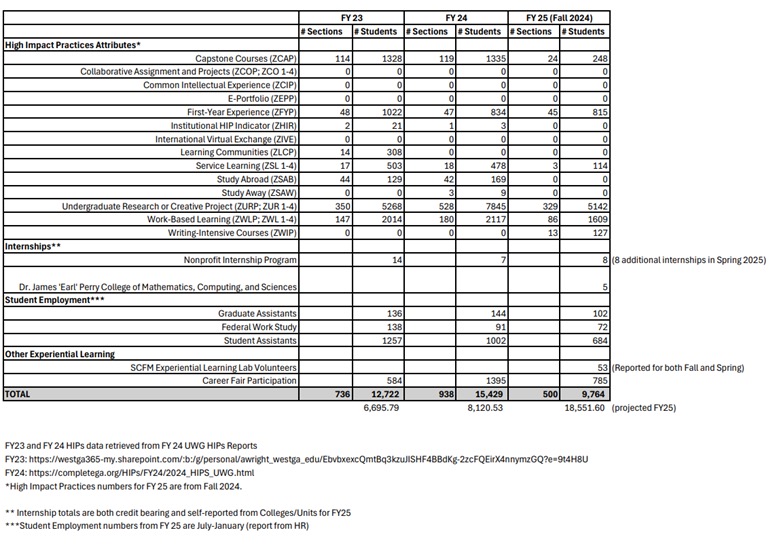
Creation of Experiential Learning Inventory: This inventory provides a standardized, centralized way to track all experiential learning activities within the schools and colleges. This inventory enables deans and administrators to document student participation in internships, field research, service-learning projects, and other real-world learning experiences efficiently (e.g. internships).
- 11 units across campus provide information for the experiential learning inventory
- 7 colleges and schools, in addition to Career Services, Human Resources, Registrar Data, and Business & Partnership Development
- Data included in the chart below:
- Development of Career Readiness Modules: Wolves Ready to Work (current enrollment of 32 students)
- Professional Development Opportunities: Number of QEP-related professional development opportunities for faculty and staff
- Fall 2024: 80 Faculty attended the Faculty Kick-Off event at which the QEP was introduced as a model for enhancing career readiness across campus.
- Spring 2025: Two opportunities provided since January 2025 for professional development, including QEP Kick Off (February), the QEP Summer Institute (June)
- QEP Kick Off: 57 Faculty and staff representing six colleges/schools and multiple business units across campus
- QEP Summer Institute: 6 faculty participants
- Increases in undergraduate research/creative projects and work-based learning opportunities:
|
Number of Undergraduate Research/Creative Projects HIP Designations and Work-Based Learning HIP Designations per College or School. |
|||
|
College or School |
Fall |
Spring |
Total |
|
College of Business |
10 |
15 |
25 |
|
College of Education |
27 |
23 |
50 |
|
College of Humanities, Arts, & Social Sciences |
53 |
104 |
157 |
|
College of Mathematics, Computing, & Sciences |
54 |
62 |
116 |
|
Honors College |
---- |
5 |
5 |
|
No College Designated |
6 |
---- |
6 |
|
School of Communication, Film, & Media |
17 |
35 |
52 |
|
School of Nursing |
12 |
9 |
21 |
|
University College |
7 |
19 |
26 |
|
Totals |
186 |
272 |
458 |
- The Institute for Faculty Excellence (IFE) partnered with the Richards College of Business to develop Richards EDGE –a dynamic, non-credit hour career readiness program designed to help their students build essential professional skills while earning digital badges that showcase their growth. 1,900 RCOB students enrolled in this pathway.
- The IFE and the Perry College of Mathematics, Computing, & Science developed an experiential learning course, designed to help students explore, engage, and reflect on a wide variety of experiential learning opportunities that will prepare them for future professions and careers. Students participate in hands-on experiences—from internships and service learning to research projects and creative endeavors—that help them discover their strengths, build essential skills, and connect their academic learning to real-world challenges. Students also utilize guided reflections on these experiences to deepen their understanding and articulate their growth. 1,400 CMCS students enrolled in this experiential learning pathway.
- Wolves Ready for Work is a brief yet impactful interactive online course designed to help students understand what professionalism truly looks like and how to apply it in real-world settings. The course includes six short topical modules, each focused on a key aspect of workplace readiness, and a concluding module about Career Service, and each module includes a quick assessment to reinforce the content covered. A final assessment at the end brings everything together. Faculty and staff who are leading internships or other career-related experiences can have their students enrolled in this course. Upon completion, students earn a certificate that can be included in their portfolios and shared with potential employers. 66 students are enrolled in Fall 2025 for the pilot. The project will target all capstones, internships, etc. in the spring.
QEP Updates: The first year of QEP implementation has yielded several demonstrable benefits that reflect both direct and indirect impact on institutional capacity and student learning:
- Expanded awareness of experiential learning opportunities, with all colleges and schools engaged in the development of QEP-related initiatives, including the establishment of competency-based and/or experiential learning badging programs.
- Documented increases in student participation in both internal and external internships.
- Recognition of the institutional need to comprehensively document all experiential learning activities to ensure continuous improvement and enhanced accountability.
- Expanded cross-campus collaboration to design and implement initiatives that cultivate career-ready competencies, including the development of an online training module to equip students with essential professional skills for workforce entry.
- Development and dissemination of targeted campaigns to increase awareness and participation among students, faculty, and staff across all levels, with messaging tailored from first-year cohorts to graduating seniors.
- These outcomes demonstrate measurable progress toward the goals outlined in the QEP and provide evidence of UWG’s commitment to advancing experiential learning, faculty engagement, and student career readiness as central components of institutional effectiveness.
QEP Future Actions:
Following the refinement of assessment instruments by the QEP Implementation and Assessment Team, along with the streamlining of dissemination and evaluation processes, the enhancement of experiential learning principles, the promotion of career competencies, and the establishment of mechanisms to strengthen faculty awareness and engagement, priorities for the upcoming year will include:
- working with the faculty and schools in identifying and better understanding faculty development needs as part of the university’s commitment to support the QEP,
- increasing involvement with promotion and student awareness to demonstrate to our students that career competencies are valued and an integral part of their university experience and education, and
- to provide more fine-tuned response to assessment findings and potential ventures.