Course Design 101: Knowledge, Skills & Abilities
First-year English and math courses serve as the foundational bedrock of undergraduate education. As a first step of reimagining these courses and a standard first step in course design, we will work systemwide to identify the essential Knowledge, Skills, and Abilities (KSAs) required to prepare students for four critical domains: further study in their major, career readiness, engaged citizenship, and life in general.
What’s the difference between Knowledge, Skills, and Abilities?
KSAs represent distinct layers of human competence. The fundamental difference lies in how they are acquired, measured, and applied.
- Knowledge is the theoretical understanding (The "What"). Acquired through reading, instruction, and study, it is the principles, concepts, and information stored in the brain.
- Skills are the proficiencies developed through practice (The "How-To"). A skill is the physical or mental execution of a task. Having knowledge does not automatically mean you have the skill; skills require hands-on application and repetition to master.
- Abilities are the enduring traits or capacity to apply KSAs to novel situations (The "Can-Do"). Abilities represent a person's deeper, often innate or highly developed capacity to perform a behavior. They dictate how effectively someone can synthesize their knowledge and skills to solve unfamiliar or complex problems.
To illustrate how these concepts work together, consider what it takes to drive a car:
- Knowledge: You memorize the driver’s handbook. You know that a red light means stop, and you understand how an internal combustion engine works.
- Skill: You practice mastering parallel parking, smooth braking, and shifting gears.
- Ability: You are driving in a torrential downpour when a car suddenly hydroplanes in front of you. Your ability is the situational awareness, spatial reasoning, and rapid decision-making required to safely navigate the hazard without panicking.
These KSAs should go beyond specific course concepts and identify overall what we hope general education courses may achieve. One holistic approach to identify these KSAs was developed by L. Dee Fink in his 2003 book Creating Significant Learning Experiences.
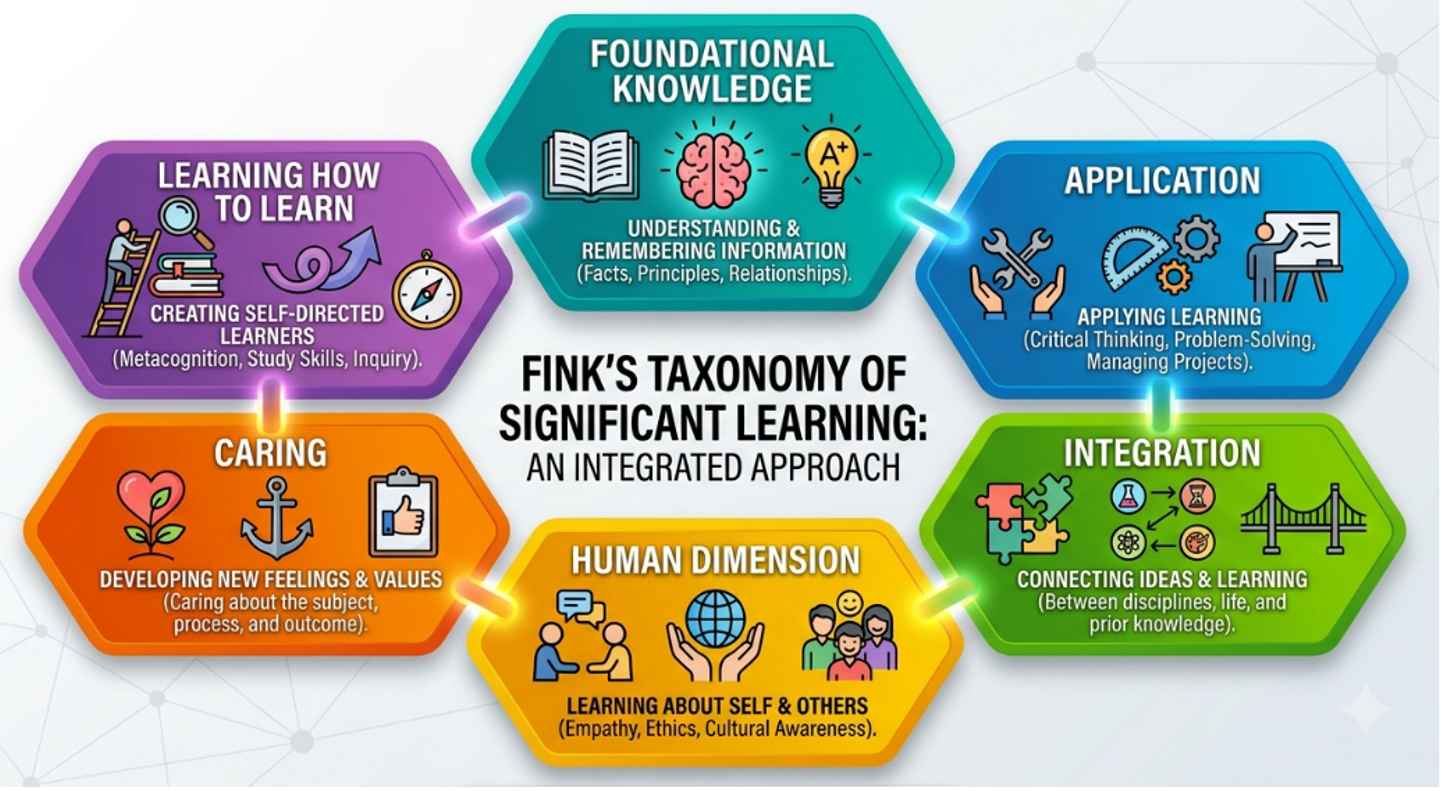
Rather than structured as a ladder to climb, Fink’s Taxonomy of Significant Learning is relational and integrated, illustrating six distinct, interactive dimensions of learning that are equally crucial for a holistic education. The taxonomy starts with Foundational Knowledge (remembering and understanding core concepts) and progresses directly into Application (critical thinking and problem-solving) and Integration (connecting distinct ideas or disciplines). Fink expands learning to include affective and metacognitive domains: the Human Dimension (understanding self and interacting with others), Caring (developing new feelings, interests, or values toward the subject), and Learning How to Learn (becoming a self-directed, curious inquirer). Because the dimensions interact, achievement in one often enhances progress in others, which results in truly significant, long-term learning outcomes.
KSAs for Academic, Career, Civic, and Personal Success
Preparation for Further Study in the Major
Gen Ed courses must build the cognitive scaffolding and discipline required for major coursework. To ensure adequate preparation for the major, faculty should look vertically and discuss the following with instructors from various disciplines.
- Vertical Curricular Mapping: What are the top three systemic weaknesses or skill gaps you notice in students entering your major courses?
- Prerequisite Bottleneck Analysis: Review high-DFW (Drop, Fail, Withdraw) foundational courses in the majors. What are the exact cognitive hurdles (e.g., specific quantitative reasoning skills or reading dense academic literature) that cause students to struggle?
Preparation for Career Readiness
To bridge academia and the modern workforce, Gen Ed must cultivate highly adaptive "human skills" that automation cannot easily replicate. Faculty do not need to guess what the modern workforce requires; they can leverage standardized frameworks and local employer networks.
- Cross-Reference the NACE Competencies: Faculty groups can audit their course goals against the National Association of Colleges and Employers (NACE) core career readiness competencies, which also served as a framework for the USG Career Ready Competencies.
- Convene Local Industry Advisory Boards: Host a structured focus group with local employers, alumni, and regional industry leaders to discuss which skills are most important and most lacking in recent graduates entering the workforce.
Preparation for Engaged Citizenship
Higher education carries a civic mandate to prepare students to participate constructively in a democratic society. Defining civic readiness requires looking at the contemporary challenges of democratic participation, media consumption, and community involvement.
- Analyze Contemporary Media and Digital Landscapes: Faculty can evaluate the precise skills required to navigate modern information ecosystems. This includes identifying abilities in data literacy, identifying algorithmic bias, and practicing civil discourse.
- Consult Civic Frameworks: Utilize established rubrics, such as the AAC&U’s Civic Engagement VALUE Rubric. This helps faculty break down "citizenship" into measurable KSAs like civic communication, intercultural knowledge, and civic action/reflection.
Preparation for Life in General
Ultimately, education must enrich the individual, fostering personal resilience, adaptability, and cognitive well-being. This domain focuses on personal resilience, adaptability, and cognitive well-being. Because it is broad, faculty should ground it in practical adulthood and lifelong learning.
- Map to "Learning How to Learn": Faculty can identify the metacognitive skills students need to self-regulate. Groups can ask: "What self-directed study habits, time-management skills, or adaptive mindsets do students need to handle unexpected life transitions?"
- Identify Practical Literacy Gaps: Collaborate with student affairs, financial aid officers, and campus wellness counselors to identify the real-world pressures students face. This helps faculty target essential life KSAs like financial literacy, stress-management techniques, and logical decision-making frameworks.
ReImagining Team
Contact Us
Aimee Berger
aimee.berger@usg.edu
Duane Day
duane.day@usg.edu
Jonathan Watts Hull
jonathan.hull@usg.edu
Melanie Largin
melanie.largin@usg.edu
Laura Lynch
laura.lynch@usg.edu
Jennifer Palmer
jennifer.palmer@usg.edu