Continued Focus: Transforming Learning Support
Learning Support has a Massive Student Footprint: Across the University System of Georgia (USG), this population exceeds 40,000. At an institutional level, 19 institutions have 10% or more of their student population enrolled in learning support classes, with 10 having 20% or more.
The Evolution of Remediation
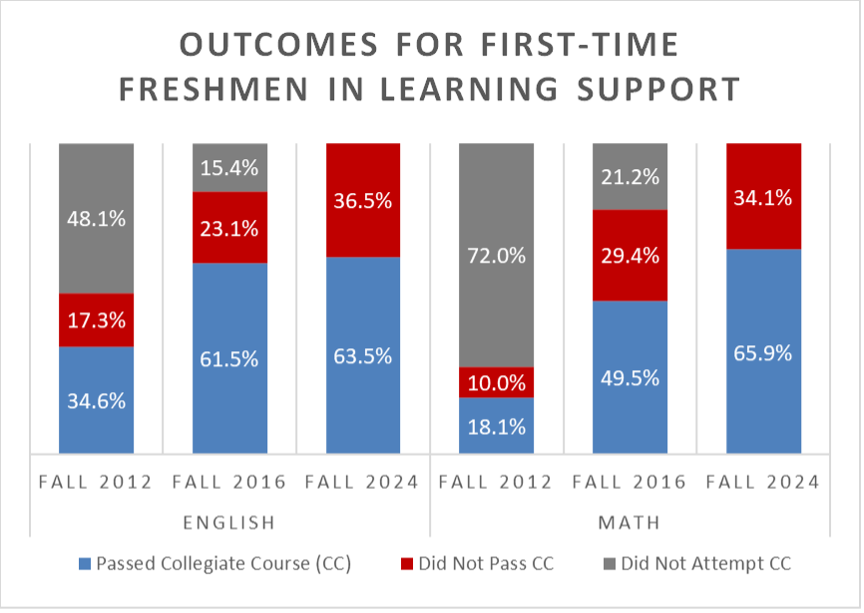
Prior to Fall 2013, all learning support in Georgia focused on prerequisite remediation. From 2013 – 2019, the USG had a mix of prerequisite and corequisite remediation models before moving fully to corequisite support, where students simultaneously enroll in the credit-bearing gateway course with an aligned support class. The benefits of corequisite support are evident: roughly twice as many students in English learning support and nearly four times as many students in mathematics learning support (including three times as many students placed in College Algebra specifically) are getting credit for collegiate level courses.
Understanding Corequisite Support
Since the inception of corequisite support, there have been different approaches used across the USG.
- Content: Often dubbed as “just-in-time” remediation, covering those topics students need to support their understanding of content in the collegiate course, corequisite courses can also preview or review content from the collegiate course and provide intentional opportunities for collaboration between the student, their classmates, and the instructor. Increasingly, corequisite courses are also focusing on development productive academic mindsets and on college readiness skills.
- Structure: Variations include the amount of class time, with practices ranging from 1 – 3 credits, whether the corequisite support course occurs before or after the collegiate course each week, whether the same or different instructors are used in the collegiate and corequisite courses, whether corequisite students are comingled with non-learning support students in the collegiate course.
- Placement: Today, placement into learning support looks at a student’s high school GPA (HSGPA) along with any test scores they may have (e.g., SAT or Accuplacer). However, institutions have also implemented other innovative practices, including creating homegrown placement exams, placement processes that include components of self-guided placements, and utilizing the preparatory courses in FreeCampus. The USG sets minimum standards for HSGPA and test scores based on systemwide student success data and predictive modelling, but institutions can require higher thresholds.
HSGPA Thresholds for Learning Support Placement
Systemwide minimum HSGPA thresholds for corequisite placement, effective fall 2026, are 3.2 for College Algebra, 2.7 for the other Math options, and 2.5 for English Composition. These scores were based on probability of success models that compared the success of students at varying HSGPAs if they were placed into the collegiate course without corequisite support and if they were placed into the collegiate course without support. The data shows that that across the system, for HSGPAs below these thresholds, students succeed at higher levels when provided corequisite support while for HSGPAs at/above these thresholds, students succeed at higher levels without corequisite support. As minimums, institutions may choose to set higher HSGPA threshholds. However, such decisions should be based on local data. The USO stands ready to help institutions with such analyses.
The Prerequisite Hurdle to College Algebra
Although the USG no longer offers prerequisite remedial courses, students who are less academically prepared (e.g., HSGPA < 2.7) cannot place directly into College Algebra even with corequisite support. Instead, they must first attempt a different mathematics course (MATH 1001, MATH 1101, or MATH/STAT 1401) with corequisite support. The idea here was that students needed stronger critical thinking and analytical skills to succeed in college algebra. However, the data does not support this argument. Looking at probabilities of success for students at any given HSGPA (which has been shown to be the strongest predictor of collegiate course success), students are more likely to pass College Algebra if placed directly into College Algebra rather than first taking a different math course followed by taking college algebra. This holds even at the very lowest HSGPAs. As such, institutions can now enroll students directly into college algebra with corequisite support for students with any HSGPA below 3.2, with an approved action plan showing how they will ensure only students who truly need college algebra are placed into it.
Addressing the Ceiling Effect & Next Steps
Despite significant progress, data reveals a "ceiling effect" where collegiate course success for corequisite students is bounded by the collegiate course pass rates in general. Making significant improvements in learning support will require a reimagining of the collegiate courses themselves. However, there is still room for improvement in the corequisite courses. Key adjustments include localized pilots to augment the structure of the corequisite courses for math and/or English, pilots on innovative placement practices to determine if students would benefit from corequisite remediation, ensuring students are properly advised into the correct math pathway and placing students in the STEM pathway into college algebra with support directly.
ReImagining Team
Contact Us
Aimee Berger
aimee.berger@usg.edu
Duane Day
duane.day@usg.edu
Jonathan Watts Hull
jonathan.hull@usg.edu
Melanie Largin
melanie.largin@usg.edu
Laura Lynch
laura.lynch@usg.edu
Jennifer Palmer
jennifer.palmer@usg.edu