Course Design with the Context-Driven Elements Framework
First-year English and mathematics courses serve as the foundational bedrock of undergraduate education. As a vital step in reimagining these gateway courses and establishing modern standards for instructional design, institution-wide efforts focus on preparing students across four critical domains: further study in their major, career readiness, engaged citizenship, and life in general.
To meet the evolving demands of higher education and the modern workforce, we will use a Context-Driven Elements Framework:
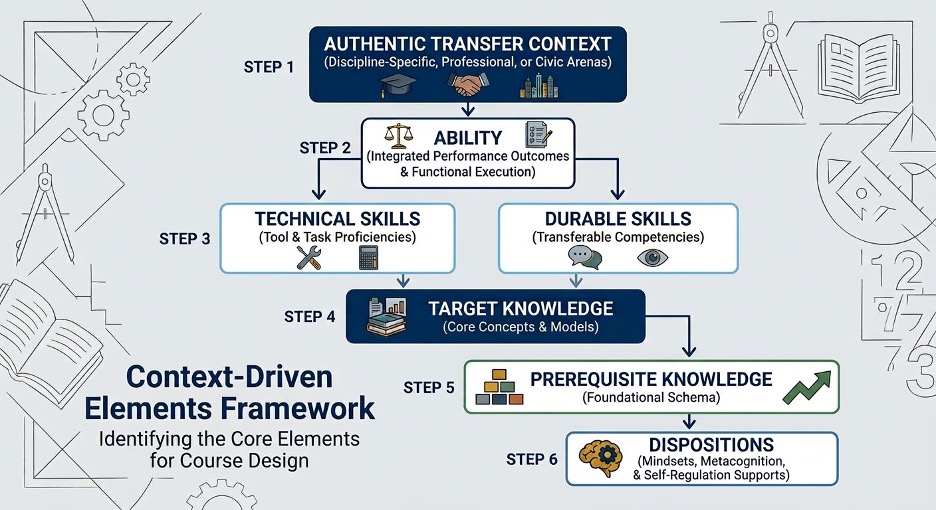
Whereas traditional course design treats competencies as isolated categories, the Context-Driven Elements Framework arranges learning into six interconnected steps to identifying what students need to be successful:
- Authentic Transfer Contexts: The disciplinary, professional, and civic environments where students will need to independently apply integrated quantitative reasoning and written communication to solve unscripted problems.
- Abilities: The capacity to perform complex, multi-step tasks by integrating knowledge, skills, and judgment within a specific transfer context (e.g., translating raw data into an executive recommendation).
- Technical Skills: Specific, teachable abilities and tool proficiencies required to complete defined tasks (e.g., computing logarithmic growth models, calculating confidence intervals, or applying citation formats).
- Durable Skills: Broad, transferable human competencies—such as critical data skepticism, logical deduction, and clear argumentation—that retain value across disciplines, industries, and time.
- Target Knowledge: Core disciplinary concepts, theoretical principles, and mental models that students must master (e.g., statistical distributions, rates of change, or rhetorical modes).
- Prerequisite Knowledge: Foundational concepts, prior schema, and entry-level operations required before a student can successfully acquire target knowledge (e.g., evaluating linear expressions or constructing a structured thesis statement).
- Dispositions: The internal mindsets, self-efficacy, metacognitive habits, and emotional regulation strategies needed to engage productively with complex tasks (e.g., dismantling math anxiety or embracing productive struggle).
Conceptual Illustration: Navigating Hazards vs. Learning to Drive
To understand how these six elements operate together, consider the expanded driving analogy:
- Authentic Transfer Context: Driving during a sudden, severe thunderstorm on a crowded freeway.
- Ability: Safely maintaining vehicle control and responding to a hydroplaning car ahead through rapid situational assessment and decision-making.
- Technical Skill: Operating anti-lock brakes, steering out of a skid, and activating hazard signals.
- Durable Skill: Spatial awareness and defensive risk assessment.
- Target & Prerequisite Knowledge: Understanding traction and traffic laws (Target), while retaining memory of vehicle control functions and road sign meanings (Prerequisite).
- Disposition: Overcoming panic, regulating emotional stress, and maintaining confidence during unexpected emergencies.
Aligning Course Design for Academic, Career, Civic, and Personal Success
Faculty auditing courses can ground their curriculum in four essential preparation domains using concrete alignment strategies:
Preparation for Further Study in the Major
Gateway courses must prepare students for advanced inquiry in upper-division coursework.
- Symbolic & Textual Translation: Train students to translate complex narrative scenarios into mathematical models or structured analytical essays.
- Interdisciplinary Case Analysis: Use real-world case studies that require integrating quantitative evidence with qualitative argumentation.
To help identify these situations, faculty can look vertically and discuss the following with instructors from various disciplines.
- Vertical Curricular Mapping: What are the top three systemic weaknesses or skill gaps you notice in students entering your major courses?
- Prerequisite Bottleneck Analysis: Review high-DFW (Drop, Fail, Withdraw) foundational courses in the majors. What are the exact cognitive hurdles (e.g., specific quantitative reasoning skills or reading dense academic literature) that cause students to struggle?
Preparation for Career Readiness
To bridge academia and the modern workforce, general education must cultivate technical proficiency alongside adaptive human capabilities. Faculty do not need to guess what the modern workforce requires; they can leverage standardized frameworks and local employer networks.
- Cross-Reference the NACE Competencies: Faculty groups can audit their course goals against the National Association of Colleges and Employers (NACE) core career readiness competencies, which also served as a framework for the USG Career Ready Competencies.
- Convene Local Industry Advisory Boards: Host a structured focus group with local employers, alumni, and regional industry leaders to discuss which skills are most important and most lacking in recent graduates entering the workforce.
Preparation for Engaged Citizenship
Higher education carries a civic mandate to prepare students to participate constructively in a democratic society. Defining civic readiness requires looking at the contemporary challenges of democratic participation, media consumption, and community involvement.
- Analyze Contemporary Media and Digital Landscapes: Faculty can evaluate the precise skills required to navigate modern information ecosystems. This includes identifying abilities in data literacy, identifying algorithmic bias, and practicing civil discourse.
- Consult Civic Frameworks: Utilize established rubrics, such as the AAC&U’s Civic Engagement VALUE Rubric. This helps faculty break down "citizenship" into measurable elements like civic communication, intercultural knowledge, and civic action/reflection.
Preparation for Life in General
Ultimately, education must enrich the individual, fostering personal resilience, adaptability, and cognitive well-being. This domain focuses on personal resilience, adaptability, and cognitive well-being. Because it is broad, faculty should ground it in practical adulthood and lifelong learning.
- Embed "Learning How to Learn": Explicitly teach metacognitive self-regulation strategies, helping students monitor their understanding and adjust study strategies.
- Address Practical Literacy Gaps: Partner with campus student affairs, financial aid, and wellness centers to address practical challenges like financial planning, stress management, and logical decision-making.
Theoretical Foundations & Conceptual Integration
The Context Driven Elements Framework synthesizes foundational and contemporary pedagogical models to create an actionable blueprint for course design grounded in what students need for success (in our case, for further study in their major, career readiness, engaged citizenship, and life in general).
- Backward Course Design: Grounded in the principles of Grant Wiggins and Jay McTighe (Understanding by Design, 1998), the framework begins with the desired end results—identifying authentic real-world application contexts before defining specific instructional tasks and learning outcomes.
- KSA & KSD Frameworks: It expands traditional Knowledge, Skills, and Abilities (KSA) and Knowledge, Skills, and Dispositions (KSD) models by explicitly incorporating emotional regulation, self-efficacy, and metacognitive support alongside cognitive outcomes.
- Charles A. Dana Center Skill Taxonomy: Drawing on recent research from the Charles A. Dana Center (Architecting a Kindergarten-to-Workforce Talent Pipeline, 2026), the framework delineates skills into technical skills, durable skills, and functional skills—equating functional skills with abilities executed within authentic transfer contexts.
- Fink's Taxonomy of Significant Learning: Incorporating L. Dee Fink’s model (Creating Significant Learning Experiences, 2003), the framework explicitly leverages the "Learning How to Learn" and "Human Dimension" categories. By fostering metacognitive self-regulation, self-directed study habits, and affective growth, Fink's taxonomy directly informs the framework's Dispositions layer.
ReImagining Team
Contact Us
Aimee Berger
aimee.berger@usg.edu
Duane Day
duane.day@usg.edu
Jonathan Watts Hull
jonathan.hull@usg.edu
Melanie Largin
melanie.largin@usg.edu
Laura Lynch
laura.lynch@usg.edu
Jennifer Palmer
jennifer.palmer@usg.edu