Skip to content Skip to navigation

University of North Georgia Campus Plan Update 2025

The University of North Georgia, a regional multi-campus institution and premier senior military college, provides a culture of academic excellence in a student-focused environment that includes quality education, service, research and creativity. This is accomplished through broad access to comprehensive academic and co-curricular programs that develop students into leaders for a diverse and global society. The University of North Georgia is a University System of Georgia leadership institution and is The Military College of Georgia.

Table 1: University of North Georgia Fall 2025 Census Demographics

Undergraduates only

Enrolled

Percent of UNG

Enrollment

20,317

100.00%

Full-Time

13,066

64.31%

Part-Time

7,251

35.69%

Male

8,741

43.02%

Female

11,576

56.98%

Adult Learner (age 25+)*

789

3.88%

First Generation

7,363

36.24%

Low-Income (Pell)

6,363

31.32%

Black

895

4.41%

Hispanic

3,689

18.16%

Asian or Pacific Islander

1,068

5.26%

Native Hawaiian or Pac. Isla.

17

0.08%

Amer. Indian/Alaska. Native

52

0.26%

Underserved Minorities**

5,855

28.82%

FT Vet

393

1.93%

PT Vet

131

0.64%

*Undergraduates Only


** Asian-Americans Excluded


Enrollment Update

For the second straight year, enrollment grew by more than five percent. Fall 2025 growth, after census, was a 5.3% increase over fall 2024. Dual enrollment grew by 11%, with cadet enrollment jumping 8.3% and graduate students rising by 2.7%. As a regional, public institution of higher education, UNG strives to deliver quality educational opportunities to the region it serves. UNG moves the needle for all students! Enrollment trends across key demographics have remained statistically constant over the last few years. The percentage of Pell Grant qualified recipients fluctuates between 34-36% for those students eligible to receive Pell Grant funding (undergraduate degree-seeking students). First-Generation students are also in the 35% range year-to-year as well as our Adult-Learner community at 4-5%. However, one demographic at UNG that has shown substantial increases is that of VA benefited students: a 16% increase over the last 5 years. Productive results from UNG building upon its designation as a State Leadership Institution and as the Military College of Georgia.

Table 2: Census headcount

Population

202008

202108

202208

202308

202408

202508

Growth

Overall Headcount

19,793

18,985

18,046

18,086

19,298

20,317

5.3%

Associate

5,620

4,050

3,113

2,606

2,508

2338

-6.8%

Bachelor-Civilian

11,112

11,880

12,151

12,438

13,088

13,967

6.7%

Cadet

729

702

658

637

678

734

8.3

Dual Enrollment

1560

1525

1335

1575

2055

2282

11.0%

Graduate

772

826

788

830

968

996

2.9%

The institution’s performance goals are increasing retention, graduation rates, and the overall number of degrees conferred each year (see Tables 3-4). Overall enrollment increased 5.3% in fall 2025 and overall retention is up 3.0% over fall 2024 and the highest level since the pandemic. Similarly, graduation and transfer rates for associate students rose 7% (Table 4). Associate degrees conferred continue to decline given the emphasis on bachelor's degrees where enrollment continues to grow. The number of graduate degrees awarded saw the most significant change between fiscal years 2024 and 2025 (Table 5).

Table 3: 1-Year Retention & Graduation

Institutional Peers (Benchmark)

UNG

1-Year FTF Retention—associate and bachelors (2024)

73.0%

1-Year Retention—associate degree (2024)

65.0%

1-Year Retention—bachelor’s degree (2024)

75%

1-Year Transfer Student Retention (2024)

64.0%


Table 4: Graduation Rates


Associate 3-Year Graduation/Transfer Rate (2022)

32.5%

Bachelor’s 4-Year Graduation Rate (2021)

29.3%

Bachelor’s 6-Year Graduation Rate (2019)

48.0%


Table 5: Degrees Conferred

All Levels

Associate

Bachelors

Dual Enrolled

Graduate

Number of degrees conferred FY 2025

3141

405

2262

2

472

Number of degrees conferred FY 2024

3125

497

2317

2

309

What’s Your 30?

Concerted efforts supporting a strategy of “What’s Your 30?” along with changes to orientation, advanced scheduling and advising of incoming students has increased the number of students enrolling in and earning credits to build program velocity as noted in Table 6. Additionally, UNG had a record number of students completing exams for credit (Table 7) in AY 2024-2025. The number of students, exams attempted, and credits earned all grew.

Table 6: Fall First-Time Freshman, credits earned by academic year (Source: End-of-Term Earned Hours)

Academic year

# fall FTF earned less than 24 credits

# fall FTF earned 24-29 credits

# fall FTF earned 30 or more credits

Total fall FTF enrolled in both fall and spring terms

2021-2022

1,856

1,212

999

3,463

2022-2023

1,536

1,144

1,194

3,316

2023-2024

1,272

1,458

1,184

3,391

2024-2025

1,609

1,317

1,405

3,840


Table 7: Credit by exam (CLEP, DSST, AP, IB)

2021

2022

2023

2024

2025

Number of distinct students

1,075

1,210

1,253

1,348

1,655

Number of exams

2,102

2,522

2,567

3,017

3,819

Credit hours from exams

4,680

5,170

4,950

5,743

7,939

Source: Banner database script

Dual-Enrolled Students

In academic year 2024-2025, UNG experienced substantial growth in Dual-Enrolled students, growing by thirty percent. That growth continued in fall 2025 (Table 8). Dual enrollment is an important part of UNG’s access mission and a strategy in serving students throughout the region. The percentage of dual-enrolled students matriculating to UNG is flat, though the number of students returning to UNG grew because of the overall increase in DE students. Dual-enrolled students have a strong record of success in the program, positioning these students to enter UNG or other USG institutions after graduating high school (see Tables 9-10).

Table 8 UNG Dual Enrolled

2021

2022

2023

2024

2025

# students

1,532

1,341

1,582

2,061

2,292

% of participating Seniors who matriculate to UNG after high school in Fall

25%

27%

23%

24%

23%


Table 9: UNG Dual Enrolled Matriculating to UNG

2021

2022

2023

2024

2025

# dual-enrolled students at census

1,532

1,341

1,582

2,061

2,292

% of participating Seniors who matriculate to UNG after high school in Fall

25%

27%

23%

24%

23%

% of participating Seniors who matriculate to UNG after high school in Summer/Fall

28%

29%

25%

28%

25%


Table 10: Dual Enrolled Students Credit Accumulation

Term

Headcount of Dual Enrolled Students

Credits Attempted

Credits Earned

% of All UNG Students

Fall 2021

1,532

9,434

9,054

8.03%

Fall 2022

1,341

8,110

7,710

7.40%

Fall 2023

1,582

9,189

8,946

8.71%

Fall 2024

2,061

11,557

11,281

10.5%

Success Inventory

Freshman Year Experience Course (University of North Georgia-2025)

Strategy/Project Name: 
Freshman Year Experience Course
Momentum Area: 
Purpose
Strategy/Project Description: 

Pursuant to NISS recommendations, UNG launched a 1CH FYE course with a pilot group in fall 2025. The pilot group includes all associate degree-seeking students, bachelor’s degree-seeking students in Education programs, and all students with co-requisite learning requirements. Enrollment in UNG 1101 for fall 2025 is ~1600 students

Activity Status: 
Evaluation/Assessment plan: 

In the pilot year, UNG will track the percentage of students enrolled who successfully complete UNG 1101 at the end of each term; additionally, the 1-year retention rate of students who successfully complete the course will be tracked at census each fall.

Successful completion of the course will be assessed using A-D grades at the end of each term

Progress and Adjustments: 

A course development committee designed UNG 1101 during the last academic year, and the course was approved internally by all levels of academic review. Learning objectives are focused on developing students’ sense of engagement and belonging, using appropriate campus resources to create an academic plan to reach personal goals, and awareness of one's strengths.  Finally, policies have been updated to support students’ enrollment in the course.

The course was offered as noted above to new students starting in the fall 2025 term

Plan for the Year Ahead: 

The FYE will be a required course for all new undergraduate students starting fall 2026. Preparations are under way to schedule approximately 175 sections of the course across all campuses, including online. The director of the FYE program will be hiring instructors in spring/summer 2026. 

Challenges and Support: 

Resources to offer enough sections of UNG 1101 will be one of the most significant challenges. Physical space limitations and the availability of enough qualified instructors will stretch the institution.

Contact email: 
Primary Contact: 
Michelle Eaton, Associate Vice President for Student Engagement & Success
LaJuan Simpson-Wilkey, Associate Vice President for Academic Affairs & Dean of University College

Expansion of High Impact Practices (University of North Georgia-2025)

Strategy/Project Name: 
Expansion of High Impact Practices
Momentum Area: 
Purpose
Strategy/Project Description: 

The institution is scaling the number of courses with embedded HiPs and systematically capturing those in the SIS. 

Summary of Activities: 

The institution is scaling the number of courses with embedded HiPs and systematically capturing those in the SIS. 

Activity Status: 
Evaluation/Assessment plan: 

The primary method of evaluation is tracking the # of students completing a HiP designated course.

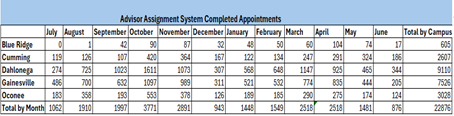
 Advisor Assignment System Completed Appointments

Progress and Adjustments: 

During the current academic year, the Center for Teaching, Learning, & Leadership has worked to systematically develop processes to more accurately capture and code course information including HiPs.

Plan for the Year Ahead: 

Continue systematic coding of HiP courses, having departments identify and tag classes at the course level that are High Impact. Monitor coding and students’ completion of HiP courses. CTLL Faculty Fellows are also updating HiP definitions including First-Year Experience and Learning Communities to the list of options instructors can use in courses.

Challenges and Support: 

No dedicated staff to ensure compliance.

Contact email: 
Primary Contact: 
Roger Runquist, Director of Center for Teaching, Learning, and Leadership

Improve consistency of Academic Advising for students (University of North Georgia-2025)

Strategy/Project Name: 
Improve consistency of Academic Advising for students
Momentum Area: 
Pathways
Category: 
Strategy/Project Description: 

Based on NISS recommendations, the institution is standardizing advising systems, protocols, training, and practices for professional and faculty advisors to ensure students receive a consistent standard of advising care across all advising units, academic departments, colleges, and campuses. 

Summary of Activities: 

Based on NISS recommendations, the institution is standardizing advising systems, protocols, training, and practices for professional and faculty advisors to ensure students receive a consistent standard of advising care across all advising units, academic departments, colleges, and campuses. 

Activity Status: 
Evaluation/Assessment plan: 

Initial KPI will be percentage of programs covered by professional advisors and the percentage of students who meet with professional advisors in 0-30CH; 31-60CH.
Assessing yearly.  Currently, we have expanded the professional advising model to include all students within all majors with Learning Support course requirements. In process of implementing expansion of Fine Arts and majors within College of Arts & Letters not currently assigned to Professional Advisors into the PA model on Dahlonega and Gainesville Campus. Additionally, expanding programs covered by PA on the Oconee Campus. Both implementations are expected to be completed by late 2025/early 2026.

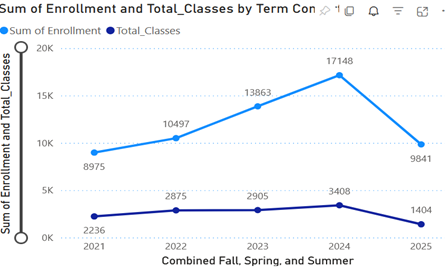
 Enrollment & total classes by term UNG

Progress and Adjustments: 

UNG has created, as recommended by NISS, an Institutional Advising Council (IAC). The IAC’s first tasks are to develop a training program for all advisors. The institution also added three additional professional advisors, thus increasing the capacity for advising to serve more students.
Based on IAC guidance, expansion of available advising training and resources for non-centralized and faculty advisors is in development. 

Additional next steps expected by IAC include standardizing use of technology to support advising

Plan for the Year Ahead: 

The IAC will build appropriate training for all academic advisors. For FY 25-26, four new advisor positions were created with one allocated to the Mike Cottrell College of Business and three for Academic Advising Centers.  

Challenges and Support: 

Funding, physical space, and training compliance for advisors.

Funding to support new advisor lines and possible purchasing of technology platform to support recommendations of technology from Advising Council

Contact email: 
Primary Contact: 
Melissa Adams, Executive Director of Academic Advising

Expanding Nursing Program (University of North Georgia-2025)

Strategy/Project Name: 
Expanding Nursing Program
Momentum Area: 
Purpose
Strategy/Project Description: 

UNG is actively monitoring enrollment trends in the Bachelor of Science in Nursing (BSN) program, specifically tracking the number of students admitted and the number of graduates each term. In response to increasing demand and in support of student success and program growth, the Nursing Department has submitted internal proposals to revise its admissions process.

To further accommodate growth and regional access, the BSN program expanded to the Cumming campus in Fall 2025, with plans underway to launch program support at the Blue Ridge campus in 2026. These strategic expansions aim to increase program capacity, address regional workforce needs, and provide greater access to nursing education across the institution’s service area

Summary of Activities: 

UNG is actively monitoring enrollment trends in the Bachelor of Science in Nursing (BSN) program, specifically tracking the number of students admitted and the number of graduates each term. In response to increasing demand and in support of student success and program growth, the Nursing Department has submitted internal proposals to revise its admissions process.

To further accommodate growth and regional access, the BSN program expanded to the Cumming campus in Fall 2025, with plans underway to launch program support at the Blue Ridge campus in 2026. These strategic expansions aim to increase program capacity, address regional workforce needs, and provide greater access to nursing education across the institution’s service area

Activity Status: 
Evaluation/Assessment plan: 

The institution monitors the number of students enrolled into the BSN nursing program and the number of nursing graduates by term.

Total Semester Enrollment

FA 22

340

SP 23

367

FA 23

358

SP 24

413

FA 24

402

SP 25

490

FA 25

516

Total Graduation Numbers by Term

FA 22

77

SP 23

86

FA 23

76

SP 24

109

FA 24

85

Sp 25

117

FA 25

84 Anticipated

Progress and Adjustments: 

The Nursing department changed its admissions processes for fall 2025. The key change was moving to a rolling admissions process rather than having fixed deadlines for applicants. The department expanded to the Cumming campus for fall 2025 enrolling 20 students on that campus. The department will expand its program to the Blue Ridge campus in 2026, and proposals have been submitted to approve that expansion.

Plan for the Year Ahead: 

Expand cohorts to the Blue Ridge campus.

Challenges and Support: 

Resources to hire faculty and partnerships with area hospitals for clinical placement of students in the program.
Funding to support new faculty lines and operations budget.

Contact email: 
Primary Contact: 
Dr. Heather Harris, Department Head, Nursing

Supplemental Updates

Observations and Next Steps

UNG continues to monitor progress towards Complete College Georgia goals and its ASPIRE metrics. The refinements to the institution’s student success efforts appear to be moving the needle positively based on data. The institution continues to monitor and refine its strategies serve students and reach a simple goal: to become a university unlike any other, serving the state of Georgia and the United States to produce dynamic, innovative, legacy-making graduates.